Dino Capovilla

Holder of the Chair
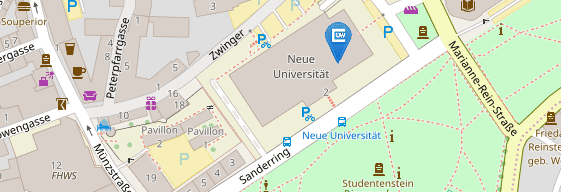
Wittelsbacherplatz 1, 97074 Würzburg, R. 02.210
Phone: +49 931 31-87628 dino.capovilla@uni-wuerzburg.de
Office hours by appointment by e-mail.
About the person
Dino Capovilla (*1979) studied computer science and philosophy in Munich and Hagen and worked for several years as a teacher of maths and computer science in South Tyrol and Germany. In 2015, he completed his doctorate with a doctoral thesis, which has since won several awards, and in 2016 he accepted an appointment at Humboldt-Universität Berlin as a junior professor of pedagogy for visual impairments. He has been a full professor at Julius-Maximilians-Universität Würzburg since 2020. His research activities focus on analysing the living conditions of people with disabilities in the tradition of the disability movement, participation through technology and interdisciplinary didactic approaches in joint teaching. Dino Capovilla is co-editor of the journal Gemeinsam Leben.
Advisory boards and memberships
Member of the advisory board of the Federal Government 's Fourth Participation Report on the living conditions of people with disabilities. Federal Ministry of Labour and Social Affairs .
Publications (All publications are available in barrier-free form. Please simply write to the first named person).
Capovilla, D., 危睿 & Gebhardt, M. (2026) 学校中对残障的解构--静态、情境性还是相对性?Gemeinsam leben 1/2026.
Joachim, S., Hennecke, M. & Capovilla, D. (2025). Understanding AI: The artificial intelligence experimentation kit. In M. Grillenberger & . Grillenberger (Eds.), Overcoming boundaries - learning from each other (pp. 317-318). Gesellschaft für Informatik e.V.
Brechtelsbauer, B., Hermanns, Y., Kugelmann, M.-C., Priebe, L., Kolbe, O., Capovilla, D. & Kunert, K.S. (2025). Tel-O-Rena - telematic ophthalmological rehabilitation aftercare. The Ophthalmology, 8/2025. p. 1-9.
Capovilla, D. & Sijp, A. (2025). Persons with visual impairment (Challenges of occupational participation of visually impaired young people). In R. Stein & W. Kranert (Eds.), From school to career and work (pp. 168-177). Kohlhammer.
Capovilla, D. (2025). Social competence as a subject matter in the specialisation area of vision. In S. Degenhardt (Ed.), Inclusion with visual impairment and blindness (pp. 120-136). Kohlhammer.
Capovilla, D. (2024). Technology-aided communication for people with visual impairments. In C. Maaß, I. Rink (Eds.), Handbook of Accessible Communication (pp. 531-546). Frank & Timme, Berlin. https://doi.org/10.57088/978-3-7929-9120-6_27
Schröter, A., Capovilla, D., Diehl, K., Link, P.C., Scheer, D., Schmid, A.C., Schurig, M., Sticca, F. & Gebhardt, M. (2023). Concepts of disability as a latent construct: A questionnaire for teacher education. Empirical special education 15(2). S. 123-140.
Capovilla, D., Falkenstörfer, S. & Gebhardt, M. (2023). The supervision of special education internships from an academic perspective. Internships in the teaching programme for special education. A guest commentary. In: Journal of Special Needs Education, Vol. 74, No. 10: pp. 446-449
Capovilla, D. (2023). "It has always been said that you can't have it both ways -
and of course you can have it both ways!" Interview with Maria Rauch-Kallert, former Austrian Federal Minister for the Environment, Health, Youth, Family and Women. Gemeinsam Leben, 4/2023. pp. 250-252.
Trees, J., Capovilla, D. & Zihl, J. (2023). On the significance of pictorial-creative drawing activities for blind children. VHN, 3/2023. PP. 212-225.
Feldmann, J. & Capovilla, D (2023). The digital literacy of learners and teachers in the field of vision. In J. Betz & J.-R. Schluchter (Eds.) School media education and digitalisation in the context of disability and impairment (pp. 81-96). Beltz-Juventa.
Capovilla, D. & Riemen, F. (2022). On life in the impaired body. Living together, 3/2022. pp. 128-134.
Capovilla, D. (2022). Research and teaching in the pedagogy of visual impairment. In The Vocational Rehabilitation 2/22. pp. 46-58.
Geimer, A. & Capovilla, D. (2022). Mediatisation of the formation of the teacher habitus? On the reception of medially represented teaching figures and the appropriation of subject norms by student teachers of special education. In: D. Matthes & H. Pallesen (eds.) Images of the teaching profession and school. (Medial) designs between production, reception and appropriation (pp. 269-290). Wiesbaden: Springer VS.
Capovilla, D. (2021). "Pädagogik bei Sehbeeinträchtigungen" Studying at the Julius-Maximilians-Universität Würzburg. In blind - visually impaired, 1/2021. p. 85-90.
Capovilla, D., Rauh, B., Dworschak W. & Gebhardt, M. (2021). Regensburg+Würzburg concept for the barrier-free design of teaching and research spaces for disability-sensitive educational processes in teacher training. Source: https://epub.uni-regensburg.de/45386/
Capovilla, D. (2021). Disabled life in the inclusive society. A plea for self-determination. Weinheim: Beltz Juventa.
Capovilla, D. & Zimmermann, R. (2020). Disabled participation in working life in the digital world. Living together, 28(1). S. 21-29.
Geimer, A. & Capovilla, D. (2020). Being blind on camera - On characteristics of the most popular international channels and videos of visually impaired Youtubers. Living Together, 28(1). S. 46-54.
Capovilla, D. (2019). Computer science education and inclusive pedagogy. In A. Pasternak (Ed.) Computer science for all - 18th GI symposium on computer science and school (pp. 35-48). Bonn: Köllen Druck + Verlag GmbH.
Capovilla, D. & Kober, A. (2019). Intelligence diagnostics in children with a visual impairment. Empirische Sonderpädagogik, 1/2019. p. 31-52. peer review.
Dorn, N., Berges, M., Capovilla, D. & Hubwieser, P. (2018). Talking at cross purposes - Perceived Learning Barriers by Students and Teachers in Programming Education. In Proceedings of WiPSCE 2018 in Potsdam/Germany (pp. 1-4). ACM. Peer Review.
Capovilla, D. (2018). Technology-enhanced communication for visual impairments. In C. Maaß & I. Rink (Eds.) Handbook of accessible communication (pp. 565-582). Berlin: Frank & Timme.
Capovilla, D., Gebhardt, M. & Hastall, M. R. (2018). "Make way, here comes a disabled person": School inclusion and problematic atypical situations using the example of learners with a visual impairment - inclusive pitfalls. In Vierteljahresschrift für Heilpädagogik und ihre Nachbargebiete (VHN), 87/1). pp. 112-125. peer review.
Capovilla, D. & Eulitz, E. (2018). Playful haptic perception promotion in children with blindness or visual impairment. In Zeitschrift für Heilpädagogik (ZfH), 1/2018. pp. 77-83.
Capovilla, D., Hubwieser, P. & Shah, P. (2016). DiCS-Index: Predicting student performance in computer science by analysing learning behaviors. In Proceedings of the LaTiCE 2016 in Mumbai/India (pp. 136-140). IEEE. Peer Review.
Capovilla, D. & Gebhardt, M. (2016). Assistive technologies for people with visual impairment in inclusive education. In Zeitschrift für Heilpädagogik (ZfH), 1/2016. p. 4-15.
Capovilla, D., Mühling, A. & Hubwieser, P. (2015). How learning styles in CS can foster inclusion of visually impaired students. In Proceedings of the LaTiCE 2015 in Taipei/Taiwan (pp. 187-192). IEEE. Peer Review.
Capovilla, D., Berges, M., Mühling, A. & Hubwieser, P. (2015). Handling heterogeneity and diversity in programming courses for freshmen. In Proceedings of the LaTiCE 2015 in Taipei/Taiwan (pp. 197-203). IEEE. Peer Review.
Capovilla, D. (2015). Inclusion in computer science education using the example of people with visual impairments. Munich: TUM School of Education. PhD thesis.
Shah, P., Capovilla, D. & Hubwieser, P. (2015). Searching for Barriers to Learning Iteration and Runtime in Computer Science. In Proceedings of the WiPSCE 2015 in London/UK (pp. 73-75). ACM. Peer Review.
Capovilla, D., Hoffmann, E., Waechter, C. & Hubwieser, P. (2014). Individualised computer science pre-projects in the school-university transition. In C. Leicht-Scholten, & U. Schroeder (Eds.) Rethinking computer science culture - concepts for studying and teaching (pp. 71-84). Wiesbaden: Springer.
Capovilla, D., Krugel, J. & Hubwieser, P. (2013). Teaching algorithmic thinking using haptic models for visually impaired students. In Proceedings of the LaTiCE 2013 in Macao/China (pp. 167-171). IEEE. Peer Review.
Capovilla, D. & Hubwieser, P. (2013). Teaching spreadsheets to visually-impaired students in an environment similar to a mainstream class. In Proceedings of the ITiCSE 2013 in Canterbury/UK (pp. 99-104). ACM. Peer Review.
Capovilla, D. & Hubwieser, P. (2013). Social inclusion as a didactic problem in computer science. In blind - visually impaired, 4/2013. pp. 226-235.
Capovilla, D. (2012). Inclusion does not work that easily. In blind - sehbehindert, 4/2012. pp. 258-262. (Since then reprinted in several other journals).